



What type of industrial fan do you need?
Choosing the wrong type of fan is the most common mistake. A very powerful unit in a poorly ventilated or badly oriented space moves air without cooling it. One that is too small for the volume of the space does not solve the problem. This quick guide will help you get it right:
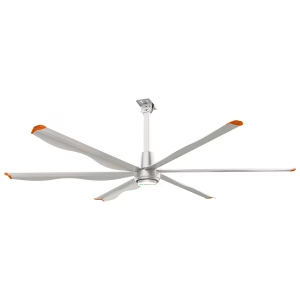
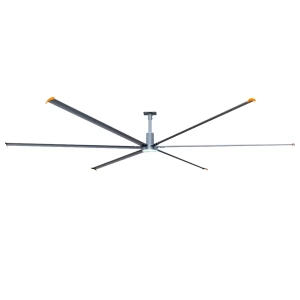
Industrial ceiling fan This is the most efficient option for buildings with a clear height of more than 5-6 metres. Installed at the highest point, it moves the entire volume of air in the space evenly, eliminating the pockets of heat that build up under the roof. A single industrial ceiling fan can cover areas of up to 1,000-1,800 m², depending on the model. In winter, by reversing the rotation, it pushes the warm air that has accumulated at the top back down to floor level, reducing heating consumption. Ideal for: industrial buildings, logistics warehouses, sports halls, distribution centres.
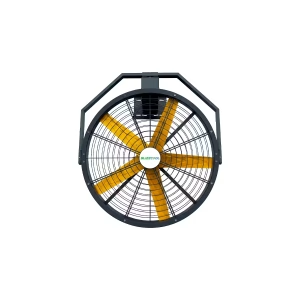
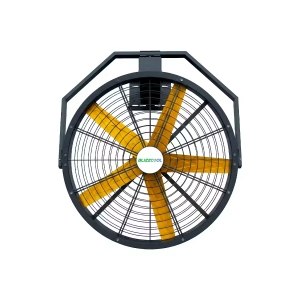
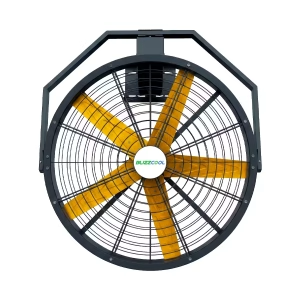
Industrial wall fan When the floor or ceiling is not an option — because of the building layout, the presence of machinery or the height of the space — the industrial wall fan is the most effective alternative. Installed at mid-height or higher up, it directs the airflow straight onto the work area and leaves the floor space completely free. Installation is simple and requires no building work. Ideal for: vehicle workshops, industrial kitchens, production lines, loading and unloading areas.
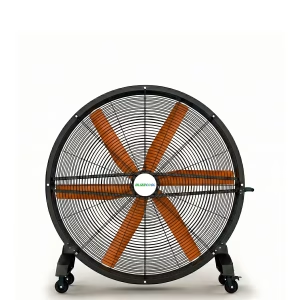
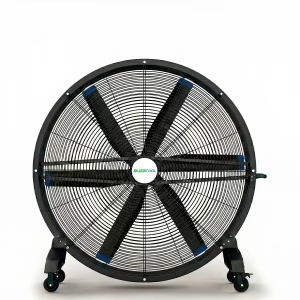
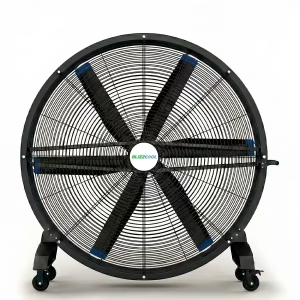
Portable industrial fan When the need is temporary, the work area changes frequently or cooling is needed outdoors, the portable industrial fan offers maximum flexibility. Fitted with wheels or ergonomic handles, these units can be relocated in minutes and direct the airflow exactly where it is needed at any given time. Ideal for: construction sites, outdoor events, facilities under renovation, temporary work areas, hospitality terraces.
Comparison · Industrial Fans
Why an industrial fan and not an air conditioner
It is the question many people ask before choosing. The answer depends on the space, but in most industrial environments active ventilation wins for several specific reasons:
Installation cost close to zero. An industrial fan requires no ducting, refrigerant gas or dedicated electrical installation. Just plug it in and switch it on. An air conditioning system for a 500 m² building can cost between €15,000 and €40,000 installed. A quality industrial fan costs a fraction of that.
Spaces that cannot be air-conditioned. Buildings with open doors, workshops with natural ventilation or warehouses with constant goods traffic do not retain the cool air from an air conditioner. Industrial fans work precisely in these conditions: they keep the air circulating and create a real cooling sensation without relying on an enclosed space.
Low consumption in continuous operation. A high-end industrial wall or portable fan uses between 60 and 300 W depending on the model. An HVLS ceiling fan, despite moving huge volumes of air, does not exceed 1.5-2 kW. Compared with the 5-15 kW of an equivalent air conditioning unit, the difference on the electricity bill is immediate.
A complement to your existing climate control system. If you already have HVAC or split units, industrial fans distribute the conditioned air better, eliminate temperature gradients and allow you to raise the thermostat by a couple of degrees without losing comfort. According to energy efficiency studies, this can cut air conditioning consumption by 20 to 30%.
Sectors and applications
Blizzcool industrial fans work in very different environments, but the common denominator is always the same: a large space where heat affects people, materials or processes.
- Industrial buildings and production — Continuous ventilation during intensive work shifts, reducing heat stress and improving concentration and performance.
- Warehouses and logistics — Air circulation in spaces with constant goods traffic and open doors, where conventional air conditioning is not viable.
- Vehicle and mechanical workshops — Removal of the heat generated by engines and tools, with wall fans that take up no useful floor space.
- Hospitality and catering — Ventilation for terraces, industrial kitchens and dining rooms without central air conditioning.
- Sports halls and gyms — Air renewal and humidity reduction in facilities with high occupancy and intense physical activity.
- Events and temporary spaces — Portable fans that can be installed and removed without building work, adaptable to any space layout.
- Greenhouses and agriculture — Temperature control and air circulation in crops where natural ventilation is not enough.
- Shopping centres and retail spaces — Greater comfort for customers and staff in areas without direct air conditioning or where heat builds up from lighting and footfall.