



Cool in summer, warm in winter
From 2.4 to 6.1 m in diameter
Quiet and maintenance-free
Up to 80% more efficient than AC
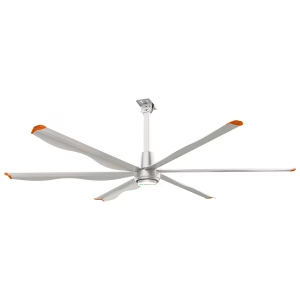
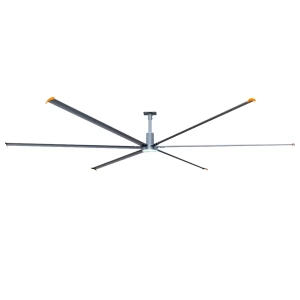
Industrial ceiling fan for buildings of any size
Most people associate power with speed. In industrial ceiling ventilation the opposite is true: the most efficient units are the ones that turn the slowest.
HVLS technology (High Volume, Low Speed) uses large-diameter blades that rotate slowly. At that speed, the blades do not create a localised draught but a descending column of air that spreads out radially when it reaches the floor, covering the whole floor area evenly.
In practice, a single HVLS industrial ceiling fan can cover from 220 m² with the most compact model up to 1,000 m² with the largest diameter, using between 0.30 and 1.5 kW depending on the model. Less than one euro a day to ventilate an entire building.
At Blizzcool we offer six models from 2.4 to 6.1 metres in diameter. The three most compact (BW series) are designed for summer ventilation in medium-sized buildings and have a fixed price with immediate stock. The three large-format models (BWP series) add a reverse function to redistribute heat from the ceiling in winter, and are configured to suit the needs of each installation.
When a ceiling fan makes sense and when it doesn’t
An industrial ceiling fan is not the right solution for every space. Being honest about this helps you make the right decision.
It makes sense when:
- The ceiling has more than 3 metres of clear height (HVLS fans need at least 4–5 m)
- The space is larger than 200 m²
- There is thermal stratification (heat at the ceiling, cold at floor level)
- Doors are frequently open and conventional air conditioning loses effectiveness
- The activity generates waste heat (machinery, people, industrial lighting)
It is not the main solution when:
- The ceiling is lower than 3 metres — in that case, a wall-mounted or portable fan is more effective
- The space is small and divided up — the HVLS air column needs free space to spread out
- You need to cool the air, not just move it — in that case, combining it with an evaporative cooler or misting system gives better results
Sectors where they are most often installed
Industrial ceiling fans are found in very different environments, but they all share one feature: large spaces with high ceilings where air movement has a direct impact on people or processes.
Logistics and distribution — Distribution centres with open loading doors are the most common use case. The HVLS fan keeps conditions stable regardless of goods coming in and going out.
Food and pharmaceutical industry — Sectors where temperature and humidity control is part of the production process. Models with a high IP rating withstand environments with high humidity, condensation and frequent cleaning.
Intensive livestock farming — Heat stress in cattle and pigs directly reduces production rates. HVLS fans improve animal welfare continuously and with minimal consumption compared with active cooling systems.
Sports halls — A 40×60 metre space with a match in progress generates an enormous heat load. A single, well-positioned ceiling fan can balance the temperature of the whole hall without creating uncomfortable draughts on the court.
Automotive and metalworking workshops — Machinery generates constant heat and fumes tend to build up at height. The ceiling fan removes that heat and dilutes airborne pollutants, improving both comfort and air quality.